
Field Notes from the Early Rochester Years

The midday sun is bright as we share a bench in the small backyard of the Rochester Zen Center. It’s September, 1971, and we’ve just been through our first sesshin. Three days and nights of inner chaos and outer novelty. Fifty-five of us were packed into the zendo, hip-to-hip kneeling in the dining room, lined up in sleeping bags on the floors of various rooms for naps.
What just happened? What kind of place is this, anyway? And, just to dream for a moment, what comes after awakening, especially after a deep experience like the one that had transformed Kapleau?
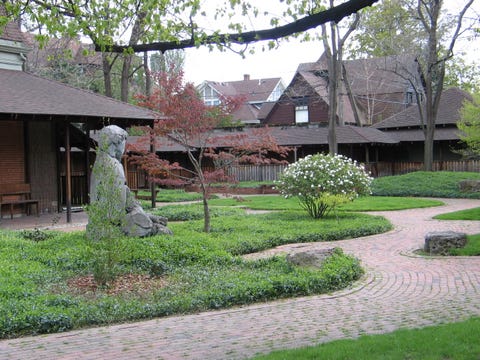
For starters, Rochester was a place of disciplined, serious practice. Philip Kapleau embodied warmth and humor, but he did not mess around.
My introductory training program at the Center earlier that year included fifteen or so other newcomers. On the second or third day, Kapleau Sensei came into the back of the room while one of his more senior students was giving us basic instructions on how to sit and about zendo etiquette. Kapleau noticed that a young woman near me was knitting or crocheting. He asked the speaker to pause, and then said to the woman, “Put down your knitting and pay attention!”
Kapleau’s main teacher, Yasutani Roshi, was born into an ancient samurai clan. Kapleau’s first three years of Zen training had been at the austere and severe monastic enclave of Hosshin-ji under Harada Roshi. Yet the profound enlightenment experience he detailed in The Three Pillars of Zen occurred while practicing as a layperson, among other lay men and women, encouraged by a head monitor who was an actual grandmother.
Kapleau had trained in some of the harshest Zen monasteries in Japan, yet over time he began to recognize that Western students might need something different. Late in his teaching career, while enjoying a walk with his long-time friend (and my current teacher) Rafe Martin, Kapleau confided to Rafe, “I am so done with Japan!”
He knew, though: strip away too much Japanese rigor and the baby goes with the bathwater.
Whether he was giving an impromptu encouragement talk in the zendo, “presenting the shout” (the literal meaning of teisho, the Japanese word for a formal Zen talk), or face to face in the dokusan room, Kapleau’s voice was distinctive — it was a bit raspy and hoarse, perhaps from his early years as a smoker. I can still hear him clear his throat as he began….
But there was something else about his voice. Remember, in my last article (https://mcspadden.substack.com/p/what-nuremberg-had-to-do-with-it ), Kapleau’s describing the feelings that amazed him when he visited the Zen monastery in Kamakura back in 1947 — “the deep serenity that seemed to radiate from the giant cryptomeria trees, the temple buildings, the faces of the monks and laymen, from the very earth itself.” That deep serenity… radiating… from the very earth itself is what his voice, and his presence, conveyed to me.
I’d been waiting in the dokusan line (dokusan is a Japanese word that literally means “going alone”) for more than forty minutes, moving up mat-to-mat, getting closer to my first formal face-to-face meeting with Philip Kapleau. It had been weeks since I’d moved to Rochester, but there were scores of new people pouring in by the month, and time in front of the teacher was rare and precious.
Finally, it was my turn, and I heard the teacher’s bell ring and the door down the hall open, so I struck the student’s bell twice, as I’d been instructed. I walked to the threshold, made a standing bow, which the teacher returned. I closed the door behind me, made a full prostration on the mat in front of him, and arranged the cushions and sat cross-legged before him.
Following the guidelines I’d been given, I stated my name, and then my practice: “I’m Larry McSpadden. My practice is counting the breath.” I remember only one other thing about that first, brief interview: Kapleau’s slightly raspy voice telling me, “We’re all either evolving or devolving, depending on causes and conditions.”
I never joined the “staff” at the RZC, but over the years have known and stayed in touch with many who did long-term residential training there. Ask any of them, and they’ll have witnessed Kapleau Roshi’s (as he eventually came to be called) ardor for diligent practice. Two or three nights each week there typically was no scheduled, formal sitting at the Center; staff members would head out those evenings to visit friends, get some ice cream, see a movie, or any one of dozens of other errands or diversions.
When they got back to the Center after an evening out, they’d see the lights on over on one side of the zendo, and they would see the Roshi in his sitting robe deeply absorbed in zazen.
Just a few years ago, a senior student of Kapleau’s and now a Zen Roshi in her own right, Mitra Bishop, shared an almost-unique pattern she’d observed in him over the years. Mitra was a long-time personal attendant and secretary of Kapleau’s. She shared (I’ll paraphrase, as I didn’t write down her exact words):
“He had what was for some people a very challenging personality. But being with him for such a long time, I could see that he never stopped working on himself. As soon as he became aware of a negative habit-pattern of behavior, it was gone. One never saw that behavior again; it was quite amazing. He worked on embodying enlightened behavior his whole teaching life and beyond, right up to his last breath.”
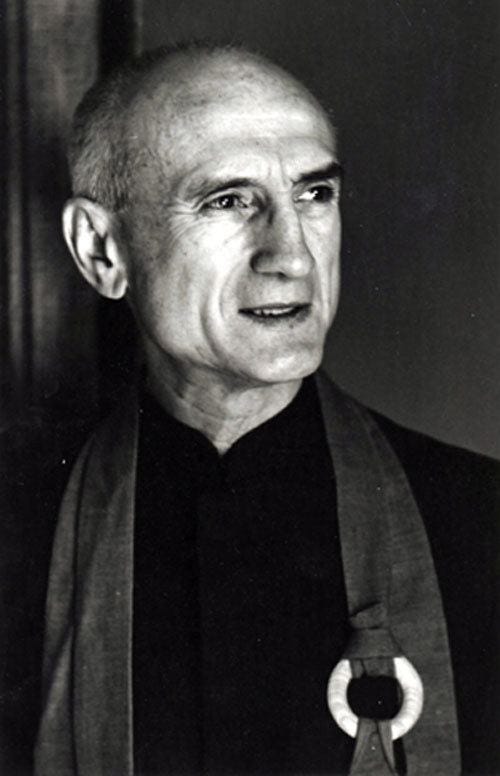
Regrettably, there have been several examples, as Zen moved to the West, of western founders (whether Asian or American) engaging in unethical behavior — having affairs with students, diverting Sangha assets for personal enjoyment, seeking fame or high standing. Such matters were never even suggested of Philip Kapleau, who often said, “Zen is not above morality, nor is morality below Zen.”
In late 1972 I tore my right medial meniscus when, in my apartment, I was asked by a friend to demonstrate the full lotus posture, and I just yanked my feet up and one knee went “pop!”
Kapleau Sensei, when he heard of my injury, had an assistant copy an article from his files explaining the anatomy of the knee and how to safely assume the lotus posture, and he sent the article to me with a kind handwritten note. Later, during a “dharma dialog” session wherein a senior student would field questions or comments from the crowd, something came up about posture and I started to share what I’d learned about knee safety. That senior student started to scoff at me, when immediately (and uncharacteristically, in that format), Kapleau interrupted him, berated him, and told him I should be listened to.
I had gone back to Indiana for knee surgery and fell in love with an old childhood acquaintance, Nancy. She came back to Rochester with me, and after a few months we were engaged.
The late summer (1973) wedding was held in the dining room (re-arranged for the event with chairs for guests, small flower arrangements, etc.) of the Zen Center. Nancy and I were kneeling on mats in front of Sensei Kapleau, ready to recite our vows, when a dinner-plate-sized wooden ring from a ceiling light fixture fell from the ceiling into my mother’s lap. Kapleau said, as a rueful aside, “The gods will have their say.”
If there’s such a thing as a “model Zen student,” that certainly wasn’t me. One afternoon I’d gotten high and drunk some beer with friends and then morosely recalled my Zen vows. I got myself to the Center and changed into my robe, and threw myself into one, then two, rounds of sitting… before I almost fainted and rolled off my cushions and mat to the floor. Peter Kjolhede (later to become my second teacher as the Dharma heir of Kapleau Roshi) was a monitor that evening; he quietly helped me to the hallway, sat me down, got some water, and took care of me. Throughout that humiliating experience, I felt not a single whiff of judgment or reproach from him.
Decades passed, and although still a fairly active RZC member, I’d moved back to Indiana, started a family, worked a career in business.... and by the early 2000’s Kapleau Roshi had retired from teaching, and for several years had taken residence in a suite now attached to 7 Arnold Park, as he was far into decline from Parkinson’s Disease. I had just sat sesshin at the new RZC country retreat facility at Chapin Mill (35 miles from Rochester) and had come into the city to say hello to my old teacher.
By that time, my youngest child Lore had been on the residential staff at the RZC for more than a year and had been, among other duties, tending to Roshi Kapleau’s needs.
When I was led into his room, I found the Roshi slumped in his chair, hands shaking, with his speech only just understandable. The late morning sun streamed into a corner of the room; he had a blanket wrapped around his legs and feet. I knelt close to him and held his hand. He asked about the sesshin and how I was doing. Then I brought up my child, and said, “I hope Lore is taking good care of you.” He shot back (although his words were slurred and ran together), “I… m… tak’g good… care… of Lore!”
Looking back over those years, what stands out most is that Kapleau never stopped practicing — not just on the cushion, but in the way he lived his life.
We’re all either evolving or devolving, depending on causes and conditions.
I’m proud to have been a student of that remarkable man who seriously lived his life in constant acknowledgement of that truth.
In the next few essays I’ll share some of the surprises that emerged for me as Zen practice unfolded over the decades.
Another lovely piece! Great to see a Zen person here who writes so well :-)
In Nov '77 I hitchhiked to Rochester to meet Kapleau Roshi and do some zazen but a nasty snowstorm impeded my journey. I returned to Mpls and got serious about practice with Katagiri Roshi. But for the weather, my life would have gone quite differently, perhaps.